Getty Center
About the Museum
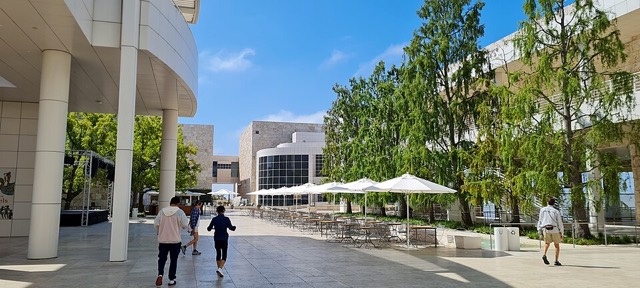
The Getty Center is a hilltop of white stone and light above the west side of Los Angeles, and its views are as much part of a visit as its collections. Richard Meier's campus of travertine and enamelled aluminium opened in nineteen ninety seven, reached by a driverless tram from the car park below, and it holds the J. Paul Getty Museum together with the Getty Research Institute, the Conservation Institute and the Foundation. Admission to the museum has always been free, as its founder wished.
The museum occupies four pavilions arranged around a central courtyard, connected by bridges and terraces. The upper floors hold paintings under natural light, arranged by period: Italian and Northern Renaissance in the North Pavilion, seventeenth century Dutch, Flemish, Italian and Spanish painting in the East, French eighteenth century art in the South and nineteenth century painting, including Van Gogh's Irises and Monet's wheatstacks, in the West. The lower floors show sculpture, drawings, illuminated manuscripts, photographs and one of the world's great collections of French decorative arts, including whole panelled rooms.
Outside, Robert Irwin's Central Garden falls in a stream down to a floating maze of azaleas, and terraces on every side look out over the city, the mountains and the ocean. The Getty's antiquities are not here but at the Getty Villa in Malibu, a separate site. Give the Center at least three hours, and if you can, stay for the sunset.
Before You Go
- Admission is free, but parking is charged and you should book a free timed entry ticket online in advance, especially at weekends.
- Take the tram up from the parking structure; it runs continuously and the ride offers the first views of the campus and the city.
- The four pavilions are linked on the upper level by bridges, so a loop through North, East, South and West covers all the paintings without backtracking.
- The Central Garden is best in the late afternoon; the plaza at the bottom has benches and lawn for a picnic.
- Photography without flash is allowed in the permanent collection galleries.
- The café and restaurant are on the courtyard level; on clear days the terraces beyond the West Pavilion give the widest view toward the Pacific.
- The Getty Villa in Malibu holds the antiquities and is a separate visit; both sites are closed on Mondays.
Collection Areas
Highlights
11 works. Each work has a full written and audio guide.


