Museums
Museum Walker

Museum Walker

Contact

Sign In

Enter your email and we will send you a sign-in link. No password needed.

By continuing you agree to our Privacy Policy and Terms of Service.

or
Continue with Google

Unlock the Full Guide

Read every room and listen to every work in all museums with premium.

Unlock Now

Already subscribed?

Renews automatically. Cancel anytime.

Choose Your Language

More languages are on the way.

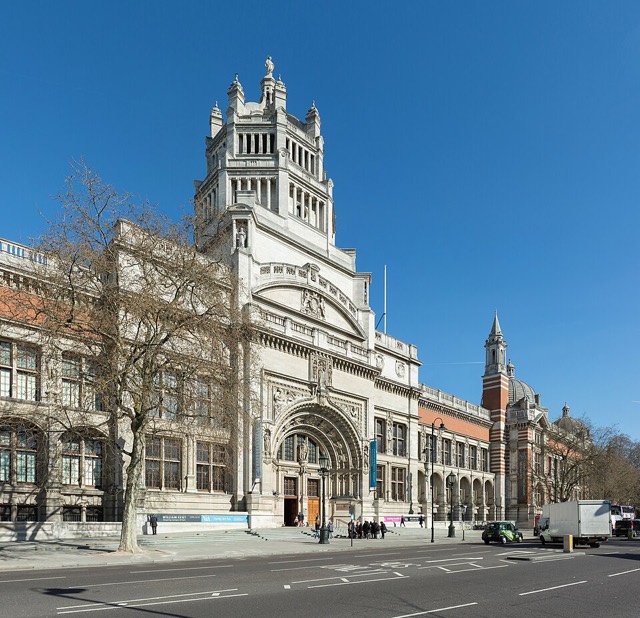
Victoria and Albert Museum

London 🇬🇧
Art / Design12 guided works
See HighlightsStart VisitingMuseum MapGet DirectionsWebsite

About the Museum

The Victoria and Albert Museum, known to everyone as the V&A, is the world's largest museum of art, design and performance. It grew out of the Great Exhibition of 1851 and the conviction of Prince Albert and Henry Cole that ordinary people and working designers should be able to study the best objects ever made. The result is a collection of more than two million things: sculpture, furniture, ceramics, glass, textiles, fashion, jewellery, metalwork, photographs, prints, theatre costume and architecture, gathered from Europe, Asia, Africa and the Americas across five thousand years.

The South Kensington building is a small city of galleries, courtyards and staircases, richly decorated in Victorian terracotta, mosaic and tile. Galleries are organised partly by place and period, as in the British Galleries, the Medieval and Renaissance rooms and the Islamic and South Asian galleries, and partly by material, as in the ceramics, glass, silver, ironwork and jewellery galleries on the upper floors. The vast Cast Courts hold full-size plaster copies of Europe's most famous monuments, and the John Madejski Garden at the centre offers a place to rest.

Entry to the permanent collection is free. First-time visitors should accept that they cannot see everything and choose two or three areas. The museum's charm lies as much in stumbling on the unexpected, a Renaissance chapel, a Frank Lloyd Wright office, a room of Chinese lacquer, as in finding the famous pieces.

Before You Go

Collection Areas

1
Medieval and Renaissance galleries
Level 0 and Level 1, Rooms 8 to 10a, 50a and 64
Ten galleries tracing European art from the fall of Rome to 1600, with the Gloucester Candlestick, the Becket Casket, the Devonshire Hunting Tapestries and Giambologna's Samson.
4
2
Cast Courts
Level 0, Rooms 46a and 46b
Two soaring Victorian halls filled with plaster casts of Trajan's Column, Michelangelo's David and the great portals and pulpits of Europe.
2
3
British Galleries
Levels 2 and 4, Rooms 52 to 58 and 118 to 125
Four centuries of British design from the Tudors to the Victorians, including the Great Bed of Ware and complete period rooms.
1
4
Raphael Court
Level 0, Room 48a
The seven surviving Raphael Cartoons, designs for the Sistine Chapel tapestries, on loan from the Royal Collection.
1
5
Islamic Middle East: The Jameel Gallery
Level 0, Room 42
Ceramics, glass, woodwork and the Ardabil Carpet, one of the largest and finest Persian carpets in existence.
1
6
Europe 1600 to 1815
Level 0, Rooms 1 to 7
Baroque and Rococo art and design, including Bernini's Neptune and Triton and a series of reconstructed interiors.
1
7
Ironwork and Metalwork galleries
Level 3, Rooms 113 to 114e
The Hereford Screen and centuries of decorative ironwork, silver and jewellery on the upper floors.
1
8
Grand Entrance
Cromwell Road entrance rotunda, Level 0
The domed main entrance hall on Cromwell Road, where the Chihuly glass chandelier hangs above the information desk. Most visits begin and end here.
1

Highlights

12 works. Each work has a full written and audio guide.

The Great Bed of Ware
1590 to 1600
British Galleries, Room 57
The Raphael Cartoons
Raphael, 1515 to 1516
Raphael, Room 48a, The Raphael Cartoons
The Ardabil Carpet
The Ardabil Carpet
Unknown, signed by Maqsud Kashani, 1539 to 1540
Islamic Middle East, Room 42, The Jameel Gallery
Cast of Trajan's Column
Monduit et Béchet, Paris, after a Roman original, about 1864, after an original of about 113 AD
Cast Courts, The Ruddock Family Cast Court, Room 46a
Cast of Michelangelo's David
Clemente Papi, after Michelangelo, about 1856, after an original of 1501 to 1504
Cast Courts, Room 46b, The Weston Cast Court
The Gloucester Candlestick
1107 to 1113
Medieval and Renaissance, Room 8, The William and Eileen Ruddock Gallery
The Becket Casket
The Becket Casket
Unknown, Limoges, about 1180 to 1190
Medieval and Renaissance, Room 8, The William and Eileen Ruddock Gallery
The Devonshire Hunting Tapestries
Unknown, Netherlandish, 1425 to 1450
Medieval and Renaissance, Room 10a (Boar and Bear Hunt); Tapestries, Room 94
Samson Slaying a Philistine
Giambologna, 1560 to 1562
Medieval and Renaissance, Room 50a, The Paul and Jill Ruddock Gallery
Neptune and Triton
Neptune and Triton
Gian Lorenzo Bernini, 1622 to 1623
Europe 1600 to 1815, Room 7, The Sheikha Amna Bint Mohammed Al Thani Gallery
The Hereford Screen
The Hereford Screen
George Gilbert Scott, made by Skidmore's Art Manufactures Company, 1862
Ironwork, Room 114c
V&A Rotunda Chandelier
Dale Chihuly, 1999, enlarged 2001
Cromwell Road Entrance, Grand Entrance rotunda