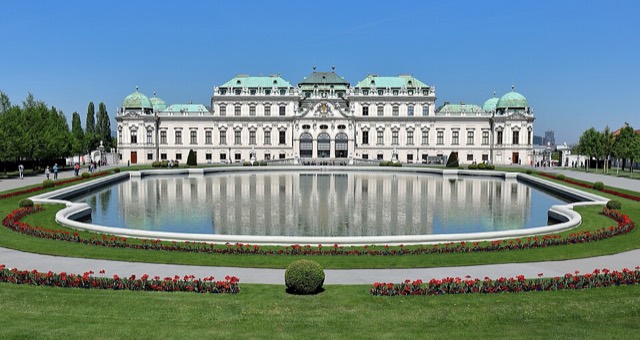
Upper Belvedere
About the Museum
The Upper Belvedere is a Baroque summer palace on a hill south of the old city of Vienna, built between about 1717 and 1723 for Prince Eugene of Savoy, the general who had driven the Ottoman armies out of central Europe. Its architect, Johann Lucas von Hildebrandt, gave it a roofline of green copper domes that was meant to look like a row of Turkish tents, and placed it at the top of a long formal garden that descends to the smaller Lower Belvedere. Today it is the home of the Austrian national collection of art, and above all of the largest group of paintings by Gustav Klimt anywhere in the world.
The display is arranged by period. The ground floor holds medieval sculpture and altarpieces alongside the Sala Terrena, the vaulted entrance hall carried by four stone giants. The first floor is the heart of the visit, with Vienna around nineteen hundred, Klimt, Schiele and Kokoschka, the Marble Hall, and rooms of Impressionism and Biedermeier painting. The second floor takes the story through Baroque art, the grimacing character heads of Messerschmidt, and the art of the nineteenth century.
First-time visitors should expect a crowd in front of The Kiss and plan to see it either right at opening or late in the day. The rest of the palace is surprisingly calm, and the view from the Marble Hall windows down the garden to the city is one of the great free pleasures of Vienna.
Before You Go
- Buy a timed ticket online; the Upper Belvedere is the busiest part of the complex and entry slots on weekends sell out.
- Go straight to The Kiss on the first floor when you arrive, then work outward; the crowd around it thins considerably in the last hour before closing.
- The Upper and Lower Belvedere are separate tickets; the gardens between them are free and open from early morning.
- Photography without flash is allowed in the permanent collection, but tripods and selfie sticks are not.
- Large bags must go in the lockers by the entrance; the cloakroom is free.
- Schiele drawings and other works on paper are rotated for conservation, so the exact selection of Schiele on the walls changes through the year; the major oil paintings stay on view.
- The palace is fully accessible by lift, and the Sala Terrena and Marble Hall are worth seeing even if you have little time for the paintings.
Collection Areas
Highlights
12 works. Each work has a full written and audio guide.


