Uffizi Gallery
About the Museum
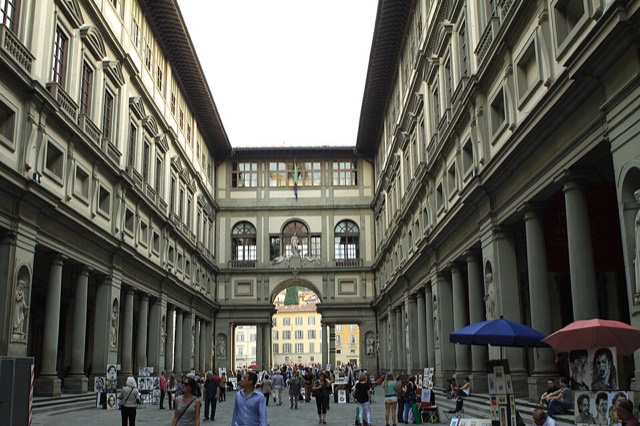
The Uffizi is the great gallery of the Italian Renaissance, housed in a long U shaped palace that Giorgio Vasari built for Cosimo I de' Medici in the 1560s as offices for the Tuscan state. The word uffizi simply means offices. Within a generation the top floor had become a display of the family's treasures, and in 1737 the last Medici heir, Anna Maria Luisa, bequeathed everything to the city of Florence on condition that it never leave. The collection runs from Giotto and the gold ground painters of the fourteenth century, through Botticelli, Leonardo, Michelangelo and Raphael, to Titian, Caravaggio and the Baroque, with ancient sculpture lining the corridors.
The route begins on the second floor, where the long corridors look out over the Arno and the Ponte Vecchio, and the rooms are numbered with the letter A. Botticelli's rooms are here, as are Leonardo and the small octagonal Tribuna. The first floor, with rooms numbered C and D, holds the sixteenth and seventeenth centuries, including Titian, Caravaggio and Artemisia Gentileschi. Room codes such as A12 or D22 are the museum's own labels and are printed on the plans.
Expect crowds and a long walk. The most famous pictures are spread across two floors, so give yourself at least three hours, or choose a dozen works and move slowly between them.
Before You Go
- Book a timed ticket in advance; the queue without a reservation can run to hours in high season.
- The visit starts on the second floor and moves down to the first; do the Botticelli rooms early before they fill up.
- The east corridor windows give a fine view of the Ponte Vecchio and the Vasari Corridor above it.
- Non flash photography for personal use is allowed.
- Large bags must be left at the cloakroom by the entrance.
- The rooftop cafe terrace beside the Loggia dei Lanzi is a good place to pause halfway through.
Collection Areas
Highlights
12 works. Each work has a full written and audio guide.


