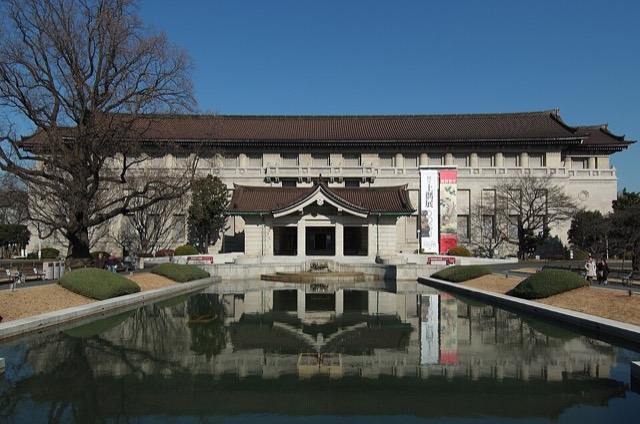
Tokyo National Museum
About the Museum
The Tokyo National Museum is the oldest and largest museum in Japan, founded in 1872 and settled since the 1880s at the northern end of Ueno Park. Its collection of around one hundred and twenty thousand objects includes more National Treasures and Important Cultural Properties than any other institution in the country: Jomon pottery and clay figures, haniwa tomb figures, Buddhist sculpture, ink paintings and gold screens, swords and armour, lacquer, kimono, tea ceramics and woodblock prints, together with a large Asian collection from China, Korea, India, Egypt and Southeast Asia.
The museum is a campus of six buildings around a courtyard. The Honkan, the grand tiled roof building facing the gate, tells the story of Japanese art chronologically on its upper floor and by genre on the ground floor. The Toyokan to the right holds Asian art. The Heiseikan behind the Honkan houses Japanese archaeology and the major temporary exhibitions. The quiet Gallery of Horyuji Treasures, a modern glass pavilion set behind a pool, displays more than three hundred seventh century objects given by the temple of Horyuji to the imperial family. The Hyokeikan, a domed Western style hall of 1909, opens only for special shows, and the Kuroda Memorial Hall by the road holds the paintings of Kuroda Seiki.
Because paintings, textiles and swords are fragile, the Japanese galleries rotate their contents every few weeks, so any particular masterpiece may or may not be out on the day you visit. The museum publishes the current display list on its website. A first visit should concentrate on the Honkan second floor route, the archaeology gallery in the Heiseikan and the Horyuji gallery, and can easily fill half a day.
Before You Go
- Start with the Honkan second floor, where rooms one to ten run in chronological order from Jomon pottery to Edo period prints; this is the museum's Highlights of Japanese Art route.
- Check the online display schedule before you go if you want to see a specific work, because paintings, calligraphy, swords and textiles are changed every few weeks.
- The Gallery of Horyuji Treasures is the calmest building on the site and is often nearly empty in the late afternoon; its gigaku masks are usually shown only on Fridays and Saturdays.
- A general ticket covers the Honkan, Toyokan, Heiseikan and Horyuji gallery; special exhibitions need a separate ticket and can draw long queues.
- Photography without flash is allowed for most of the permanent collection, but look for the no camera symbol on loan objects.
- The Honkan has a small garden with tea houses behind it that opens to the public in spring and autumn.
- Coin lockers and free umbrella stands are by the main entrance of the Honkan, and there are restaurants in the Toyokan and Horyuji buildings.
Collection Areas
Highlights
12 works. Each work has a full written and audio guide.


