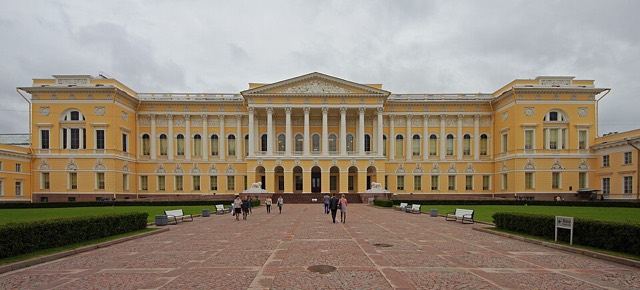
State Russian Museum
About the Museum
The State Russian Museum holds the largest collection of Russian art in the world, more than four hundred thousand works spanning a thousand years, from twelfth century icons to Soviet and contemporary art. It was founded by Tsar Nicholas the Second in eighteen ninety five in memory of his father and opened in eighteen ninety eight in the Mikhailovsky Palace, a grand neoclassical residence built by Carlo Rossi in the eighteen twenties for Grand Duke Michael.
The main circuit runs through the Mikhailovsky Palace and the adjoining Benois Wing. The palace rooms follow Russian art in order: ancient icons on the ground floor, then eighteenth century portraits, the great academic canvases of Bryullov and Aivazovsky, the realists of the Wanderers movement with Repin and Surikov, and the turn of the century with Serov and Vrubel. The Benois Wing continues into the twentieth century, with Kustodiev, Petrov-Vodkin, the avant-garde of Malevich, Filonov and Kandinsky, and Soviet painting.
First time visitors should allow at least three hours and follow the numbered halls, which keep the story roughly chronological. The museum also runs the Marble Palace, the Stroganov Palace, the Mikhailovsky Castle and the Summer Garden, each with a separate ticket, but the works in this guide are all in the main building on Arts Square.
Before You Go
- The main entrance is on Arts Square (Ploshchad Iskusstv), a short walk from Nevsky Prospekt and the Gostiny Dvor and Nevsky Prospekt metro stations.
- Halls are numbered and roughly chronological; start with the icons on the first floor and finish in the Benois Wing for the twentieth century.
- The Benois Wing has its own entrance on the Griboyedov Canal, useful if you only want the avant-garde and Soviet galleries or a temporary exhibition.
- Photography without flash is generally allowed in the permanent collection; tripods are not.
- Weekday mornings are the quietest; weekends and school holidays fill the Bryullov and Repin halls quickly.
- Coats and large bags must go to the cloakroom, and the halls can be warm, so dress in layers.
Collection Areas
Highlights
12 works. Each work has a full written and audio guide.


