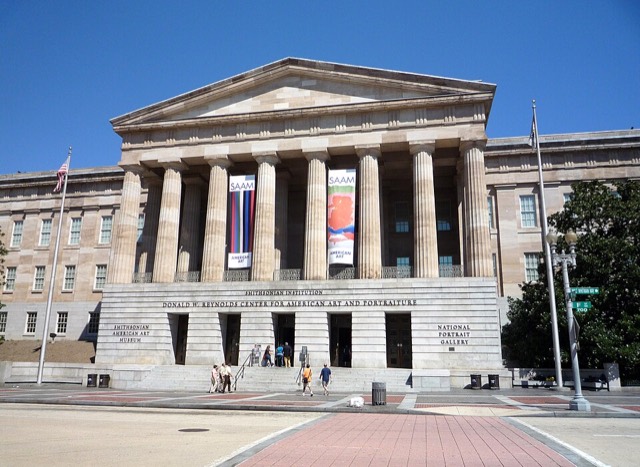
Smithsonian American Art Museum
About the Museum
The Smithsonian American Art Museum holds one of the largest and most wide-ranging collections of American art anywhere, more than forty thousand works stretching from colonial portraits to video installations. It shares the Old Patent Office Building, a Greek Revival landmark in the Penn Quarter neighbourhood of Washington, with the National Portrait Gallery. The building took more than thirty years to complete, from 1836 to 1868, served as a hospital during the Civil War, and hosted Lincoln's second inaugural ball in its great upper halls. In 2007 the open courtyard at its centre was covered with an undulating glass canopy designed by Norman Foster, creating the Kogod Courtyard, one of the most pleasant free indoor spaces in the city.
The collection is arranged chronologically over three floors. The first floor holds folk and self-taught art, including James Hampton's shimmering Throne, together with Latino and early American galleries. The second floor covers the eighteenth to the early twentieth century, with the great landscapes of Bierstadt and Moran, Catlin's Indian Gallery, Winslow Homer, Sargent and the Gilded Age. The third floor is devoted to modern and contemporary art, with the soaring Lincoln Gallery and Nam June Paik's neon map of America. Above it, the Luce Foundation Center displays thousands more works in dense glass cases, a visible storage that is a museum in itself.
Admission is free. Note that the second-floor galleries are closed for a major reinstallation until 6 November 2026, so check what is on view before you build your route around a particular painting.
Before You Go
- Admission is free and no timed ticket is needed; the main entrance is at 8th and G Streets, directly above the Gallery Place Chinatown Metro station.
- The museum opens at 11:30 in the morning, later than most Smithsonian museums, which makes it a good afternoon stop after the National Mall.
- Start on the third floor for the Lincoln Gallery and the modern collection, then go up to the Luce Foundation Center, and finish in the Kogod Courtyard on the ground floor.
- The second-floor historic galleries are closed for reinstallation until 6 November 2026; the first and third floors, the Luce Center and the courtyard remain open.
- Non-flash photography for personal use is allowed throughout the permanent collection.
- The Kogod Courtyard has a cafe, free wireless internet and plenty of seating, and it is a relaxed place to wait out rain or heat.
- The National Portrait Gallery shares the building, so you can move freely between the two museums without leaving.
Collection Areas
Highlights
12 works. Each work has a full written and audio guide.


