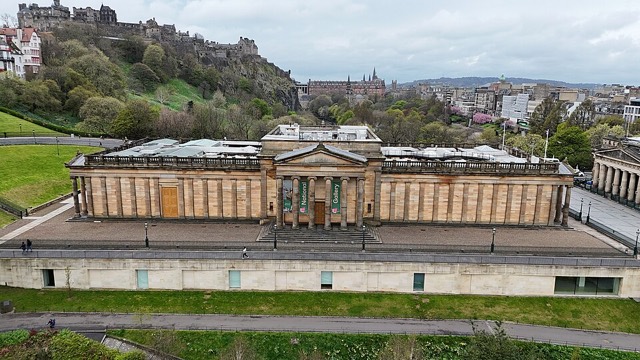
Scottish National Gallery
About the Museum
The Scottish National Gallery, now branded simply as the National, stands on the Mound in the centre of Edinburgh, a neoclassical temple by William Henry Playfair squeezed between Princes Street Gardens and the Old Town. It opened in 1859 and holds the national collection of fine art from the early Renaissance to the end of the nineteenth century, together with the finest gathering of Scottish painting anywhere in the world. The building is small enough to see in a morning, yet the quality is remarkably high: Titian, Botticelli, Velazquez, Rembrandt, Vermeer, Gainsborough, Monet and Gauguin all hang here.
The upper floor keeps Playfair's octagonal rooms with their deep red walls, where the Old Masters and the French Impressionists are shown in the traditional crowded manner. Below them, opening directly on to the gardens, are the Scottish galleries, completely rebuilt and reopened in September 2023. These bright, modern rooms tell the story of Scottish art from about 1800 to 1945, from Raeburn and Wilkie through the Glasgow Boys to the Scottish Colourists, and they are where you will find the Skating Minister and the Monarch of the Glen.
Entry to the permanent collection is free. The Royal Scottish Academy building next door, linked by an underground level, houses temporary exhibitions. A first-time visitor should plan a loop: enter from the gardens, walk the Scottish rooms, climb to the Old Masters, and finish with the Impressionists before heading back down.
Before You Go
- Admission to the permanent collection is free; only some temporary exhibitions in the Royal Scottish Academy building are ticketed.
- The entrance from East Princes Street Gardens leads straight into the new Scottish galleries and is step free; the Mound entrance leads to the upper floor.
- The gallery is compact, so two hours is enough for the highlights, but come early or late on weekdays to avoid the festival and weekend crowds.
- Titian's Diana and Actaeon is jointly owned with the National Gallery in London and moves between the two cities on five year terms; it is scheduled to be in Edinburgh from 2026 to 2030, but check the website before a special trip.
- Photography without flash is allowed in the permanent collection.
- The cafe on the garden level has a terrace facing the Scott Monument and the Castle, a good place to rest between the two floors.
Collection Areas
Highlights
12 works. Each work has a full written and audio guide.


