Pushkin Museum
About the Museum
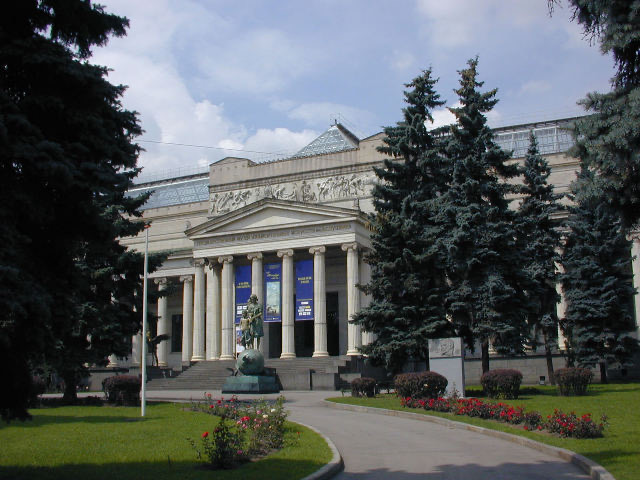
The Pushkin State Museum of Fine Arts is the largest museum of European art in Moscow and, after the Hermitage, the second in Russia. It began in 1912 as a teaching museum of plaster casts attached to Moscow University, the dream of the professor Ivan Tsvetaev, father of the poet Marina Tsvetaeva. His idea was that Muscovites who could never travel to Athens, Rome or Florence should still be able to walk among full size copies of the Parthenon frieze, Michelangelo's David and the doors of the Florence Baptistery. Those casts are still here, arranged in the grand halls of Roman Klein's neoclassical building on Volkhonka Street, and they give the museum a character unlike any other.
Around the casts the collection grew with real treasures: Egyptian mummies and Fayum portraits, the gold that Heinrich Schliemann dug up at Troy, and old master paintings by Rembrandt, Poussin and Botticelli. The greatest riches, though, came after the revolution, when the private collections of the Moscow merchants Sergei Shchukin and Ivan Morozov were nationalised. Their Monets, Renoirs, Van Goghs, Gauguins, Cézannes, Matisses and Picassos are shown in a separate building next door, the Gallery of European and American Art of the nineteenth and twentieth centuries.
Plan on two separate visits, or at least two tickets: one for the main building with its casts, antiquities and old masters, and one for the Gallery, a short walk along Volkhonka. The Gallery is smaller, quieter and, for many visitors, the reason to come.
Before You Go
- The main building and the Gallery of European and American Art are separate buildings with separate tickets; the Gallery, at Volkhonka 14, holds the Impressionists and Post Impressionists.
- Start in the Gallery in the morning when it is quiet, then cross to the main building for the casts, the Trojan gold and the old masters.
- The Italian and Greek Courtyards in the main building are the best places to sit and take in the scale of the cast collection.
- Photography without flash is generally allowed in the permanent collection, but check the rules at the entrance for temporary exhibitions.
- Kropotkinskaya metro station is directly beside the museum; the Cathedral of Christ the Saviour is across the street.
- The Volkhonka quarter around the museum has been under redevelopment as a museum campus for years; expect some hoardings and changed entrances.
Collection Areas
Highlights
12 works. Each work has a full written and audio guide.


