Museums
Museum Walker

Museum Walker

Contact

Sign In

Enter your email and we will send you a sign-in link. No password needed.

By continuing you agree to our Privacy Policy and Terms of Service.

or
Continue with Google

Unlock the Full Guide

Read every room and listen to every work in all museums with premium.

Unlock Now

Already subscribed?

Renews automatically. Cancel anytime.

Choose Your Language

More languages are on the way.

Natural History Museum

London ๐Ÿ‡ฌ๐Ÿ‡ง
Natural History12 guided works
See HighlightsStart VisitingMuseum MapGet DirectionsWebsite

About the Museum

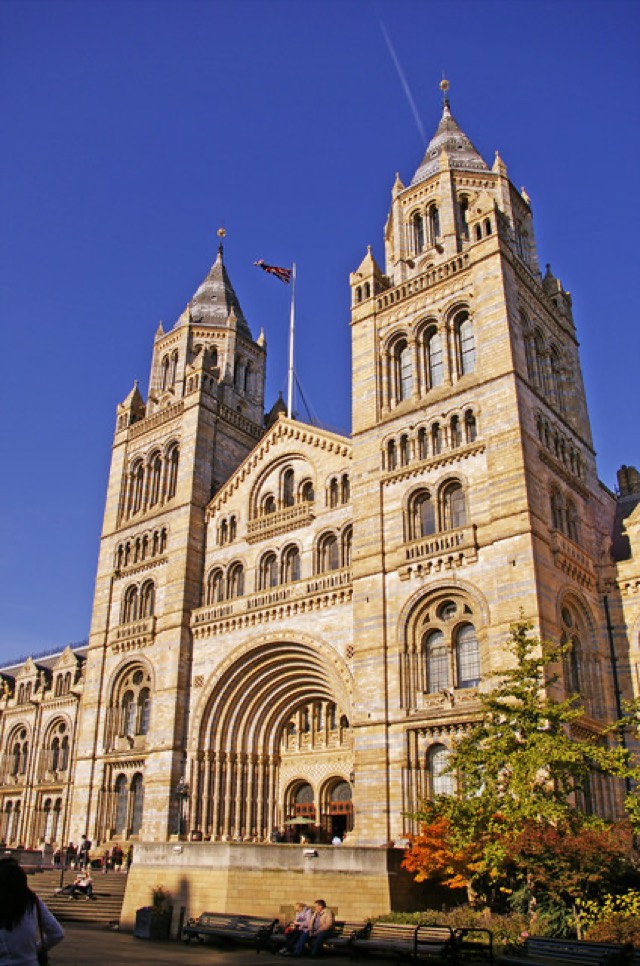
The Natural History Museum in South Kensington holds about eighty million specimens gathered over more than two and a half centuries, from the first fossils and pressed plants of Sir Hans Sloane to the meteorites and deep sea creatures collected today. It began as a department of the British Museum and moved into its own building on Cromwell Road in 1881. That building, designed by Alfred Waterhouse, is itself one of the great exhibits: a cathedral of terracotta in which every column, arch and window is decorated with sculpted animals and plants, living species on the west side and extinct ones on the east.

The collection is arranged in four colour coded zones. The Blue Zone covers dinosaurs, mammals and marine life; the Green Zone has birds, fossil marine reptiles, minerals and the Treasures gallery; the Red Zone, entered from Exhibition Road, tells the story of the planet, from volcanoes and earthquakes to the origins of life; and the Orange Zone holds the Darwin Centre with its working scientists and the wildlife garden.

A first visit should begin in Hintze Hall, where a blue whale skeleton dives from the ceiling, and then follow whichever zone suits your interests. The museum is free to enter, extremely popular with families, and calmest early on weekday mornings during school term. Allow at least three hours, and do not forget to look up.

Before You Go

Collection Areas

1
Hintze Hall
Ground floor, Cromwell Road entrance
The great Romanesque entrance hall, with the blue whale skeleton overhead, the Darwin statue on the staircase and ten Wonder Bays of star specimens along the sides.
4
2
Dinosaurs
Blue Zone, ground floor
Skeletons, skulls and an animatronic Tyrannosaurus rex, along with the story of how dinosaurs were discovered and named in Britain.
2
3
Treasures in the Cadogan Gallery
Green Zone, first floor balcony
A single room of twenty two extraordinary objects, from the Archaeopteryx fossil to a penguin egg brought back from Antarctica.
4
4
Minerals and the Vault
Green Zone, first floor
One of the oldest galleries in the museum, still in its Victorian cases, ending in the Vault where gems, gold nuggets and meteorites are displayed.
1
5
Human Evolution
Blue Zone, ground floor
Fossil skulls, casts and reconstructions that trace seven million years of human ancestry, including the first adult Neanderthal skull ever found.
6
Earth Hall and the Red Zone
Exhibition Road entrance
Sophie the Stegosaurus guards the entrance to galleries on volcanoes, earthquakes, the birth of the planet and the riches of the Earth.
1
7
Darwin Centre
Orange Zone
The eight storey Cocoon, where visitors can watch scientists at work and see how the wet and dry collections are stored and studied.

Highlights

12 works. Each work has a full written and audio guide.

Hope, the Blue Whale Skeleton
Skeleton of a whale stranded in 1891; suspended here in 2017
Hintze Hall, suspended from the ceiling
Statue of Charles Darwin
Joseph Edgar Boehm, 1885
Hintze Hall, landing of the main staircase
Mantellisaurus Skeleton
Early Cretaceous, about 125 million years ago
Hintze Hall, Wonder Bay on the ground floor
Giant Sequoia Trunk Section
Tree felled in 1891; about 1,300 years old
Hintze Hall, first floor at the top of the main staircase
Sophie the Stegosaurus
Late Jurassic, about 150 million years ago
Earth Hall, Red Zone, Exhibition Road entrance
Animatronic Tyrannosaurus rex
Kokoro Company, Installed in 2001
Dinosaurs gallery, Blue Zone, ground floor
Archaeopteryx, the London Specimen
Late Jurassic, about 147 million years ago
Treasures, Cadogan Gallery, first floor balcony
The Aurora Pyramid of Hope
Alan Bronstein and Harry Rodman, Collection assembled from 1980 onwards; on loan since 2005
The Vault, Minerals gallery, Green Zone, first floor
The Wold Cottage Meteorite
Fell on 13 December 1795
Treasures, Cadogan Gallery, first floor balcony
Gibraltar 1 Neanderthal Skull
About 50,000 years old
Human Evolution gallery, Blue Zone, ground floor
Blaschka Glass Models of Sea Creatures
Leopold and Rudolf Blaschka, 1860s to 1880s
Treasures, Cadogan Gallery, first floor balcony
Emperor Penguin Egg from Scott's Terra Nova Expedition
Collected in July 1911
Treasures, Cadogan Gallery, first floor balcony