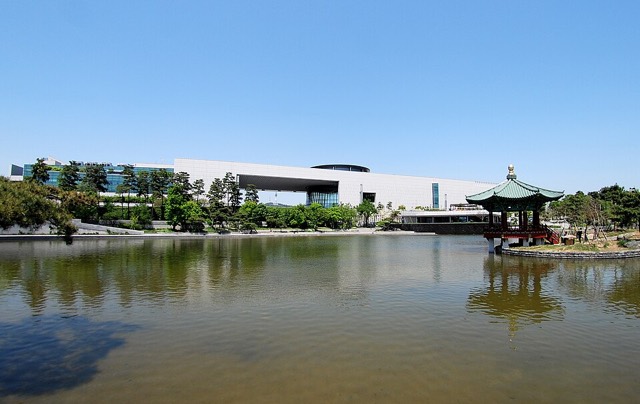
National Museum of Korea
About the Museum
The National Museum of Korea is the country's flagship museum and the place to understand Korean history and art from the Stone Age to the end of the Joseon dynasty. It moved in two thousand and five to a vast modern building in Yongsan Family Park, with a long open plaza between two wings, a reflecting pond in front and a view of Namsan and its tower behind. The collection holds hundreds of thousands of objects, and several thousand are on display at any time, including dozens of designated National Treasures.
The permanent galleries occupy three floors around a central hall called the Path to History, where the ten storey marble pagoda from Gyeongcheonsa rises through the full height of the building. The first floor covers prehistory and the ancient kingdoms of Goguryeo, Baekje, Gaya and Silla, then the Goryeo and Joseon dynasties. The second floor holds calligraphy, painting and the donated collections. The third floor is devoted to Buddhist sculpture, ceramics and metal crafts, and to art from across Asia.
A first-time visitor should start with the Room of Quiet Contemplation, a darkened space built for the two gilt bronze pensive bodhisattvas, then take in the Silla gold crowns, the Goryeo celadon and the Joseon moon jar. Entry to the permanent galleries is free, labels are in Korean and English, and the building is easy to reach by subway.
Before You Go
- Admission to the permanent exhibition is free; only some special exhibitions are ticketed.
- Take subway line four or the Gyeongui Jungang line to Ichon station; a covered walkway leads directly to the museum.
- Go to the Room of Quiet Contemplation first, before it fills up; it is on the second floor at the end of the Sculpture and Crafts route.
- The Path to History in the central hall gives the best view of the Gyeongcheonsa pagoda from several levels.
- Photography without flash is allowed in the permanent galleries.
- Free lockers are available near the main entrance, and the museum has good cafes and a large museum shop.
- Paintings and calligraphy are rotated regularly to protect them from light, so specific scrolls may not be on view.
Collection Areas
Highlights
10 works. Each work has a full written and audio guide.


