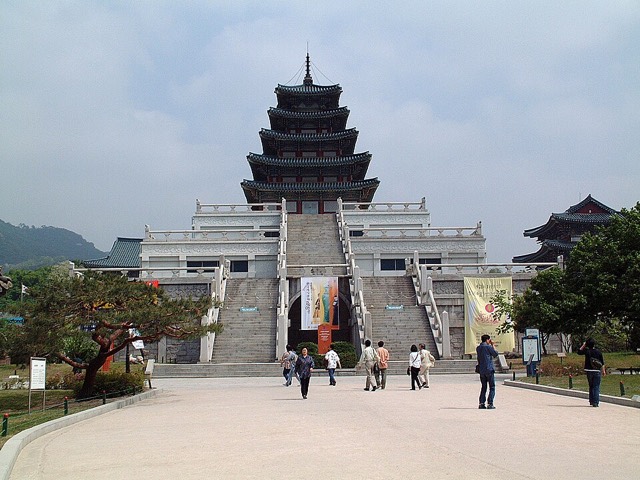
National Folk Museum of Korea
About the Museum
The National Folk Museum of Korea is the country's main museum of everyday life: how Koreans farmed, cooked, dressed, married, worshipped and were buried from prehistory to the present day. It stands inside the grounds of Gyeongbokgung Palace in central Seoul, on the eastern side of the palace, and many visitors reach it through the palace itself. The building is impossible to miss. Completed in 1972 as the home of the National Museum, it is a concrete reinterpretation of famous Buddhist temple architecture, with a five storey pagoda tower rising above terraces and a monumental staircase. The folk museum moved in during 1993.
Inside, three permanent halls tell the story in different ways. The first sets out the long history of Korean life; the second follows a year in a farming village through the seasons and the lunar calendar; the third follows a single life from birth through education, marriage and old age to the ancestral rites that continue after death. The displays mix real objects with life-size reconstructions and models, which makes the museum very approachable for visitors with no background in Korean history.
Outside, an open-air exhibition scattered across the grounds includes village guardian posts, stone figures, a relocated nineteenth century house and a full street of shops from the Seoul of the 1970s. A separate Children's Museum offers hands-on galleries. Admission is free, and an hour and a half is enough for the main halls, though the grounds reward a slower wander.
Before You Go
- Admission is free; you can enter directly from Samcheong-ro on the east side without buying a palace ticket, or walk through from Gyeongbokgung if you have one.
- The museum is closed on Tuesdays, unlike the palace, which closes on Mondays; check before you plan a combined visit.
- Start with the three permanent halls indoors, then take the open-air exhibition on the way out; the 1970s street is near the Samcheong-ro entrance.
- The Children's Museum uses timed sessions that fill up on weekends and holidays; reserve ahead if you are travelling with children.
- Photography without flash is allowed in the permanent galleries.
- The museum is a short walk from Bukchon Hanok Village and the National Palace Museum, which sits at the opposite corner of the palace grounds.
Collection Areas
Highlights
8 works. Each work has a full written and audio guide.


