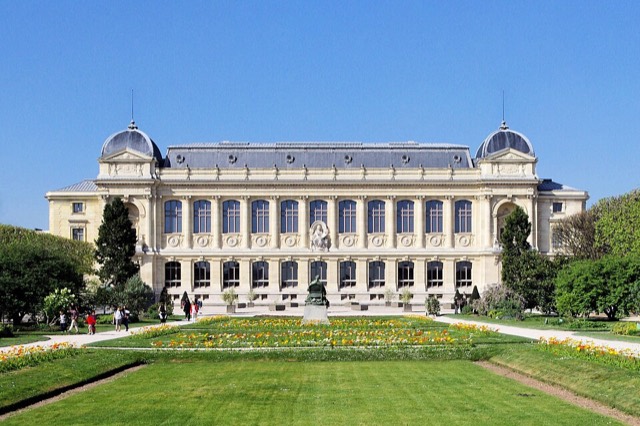
Muséum national d'histoire naturelle
About the Museum
The Muséum national d'histoire naturelle is not one building but a whole campus of galleries scattered through the Jardin des Plantes, the botanical garden founded in 1635 as the king's medicinal herb garden on the left bank of the Seine. Buffon, Lamarck, Cuvier and Geoffroy Saint Hilaire all worked here, and much of modern zoology, palaeontology and evolutionary thinking was argued out in these grounds. The collections run to tens of millions of specimens, and the public galleries show a carefully chosen fraction of them in some of the most beautiful museum interiors in Paris.
The centrepiece is the Grande Galerie de l'Évolution, a vast iron and glass hall of 1889 that was reborn in 1994 as a theatre of biodiversity, with a parade of African animals marching down the nave beneath a sky that changes colour. Across the garden the Galerie de Paléontologie et d'Anatomie comparée is a nineteenth century time capsule: a thousand skeletons on the ground floor and dinosaurs and fossil mammals above, displayed almost exactly as they were in 1898. The Galerie de Minéralogie shows giant crystals and royal gems, and the Grandes Serres, the great greenhouses, take you from tropical rainforest to desert under Art Deco glass.
Each gallery has its own ticket and its own entrance, so plan a route. A full day can cover the Grande Galerie in the morning, the greenhouses and garden at midday, and the palaeontology gallery in the afternoon. Families often add the Ménagerie, one of the oldest zoos in the world, at the northern end of the garden.
Before You Go
- Each gallery is ticketed separately; the Jardin des Plantes itself is free, so you can walk between them through the garden.
- The Grande Galerie de l'Évolution is the busiest site, especially on Wednesday afternoons and weekends when Paris school groups visit; arrive at opening time.
- The Galerie de Paléontologie et d'Anatomie comparée is at the Gare d'Austerlitz end of the garden; it is smaller, quieter and often the favourite of adult visitors.
- Most galleries are closed on Tuesdays; check the museum website before planning a visit around a Tuesday.
- Photography without flash is allowed in the galleries, and the natural light in the palaeontology gallery is best on a bright morning.
- The greenhouses are warm and humid; leave coats at the entrance lockers if you visit in winter.
Collection Areas
Highlights
12 works. Each work has a full written and audio guide.


