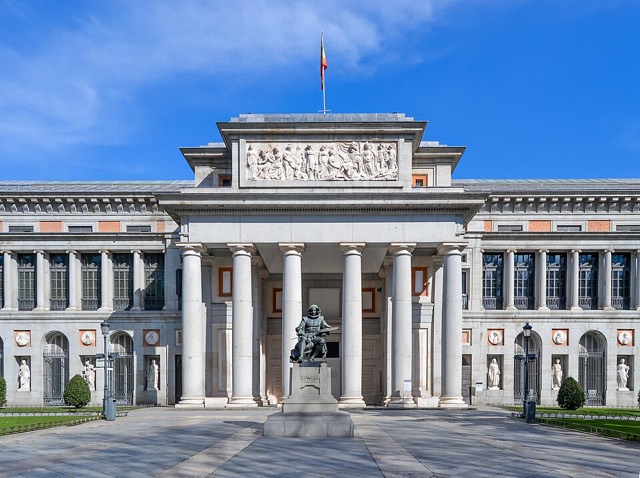
Museo del Prado
About the Museum
The Museo del Prado is Spain's national gallery of painting and one of the great picture collections of the world. It grew from the private holdings of the Spanish kings, who for three centuries bought and commissioned the best painters of Europe, and it opened to the public in 1819 in a neoclassical building by Juan de Villanueva on the Paseo del Prado. The result is a collection that is unusually deep rather than broad: nothing before the twelfth century and little after 1900, but the finest groups anywhere of Velázquez, Goya, El Greco, Bosch, Titian and Rubens.
The main Villanueva building has three floors organised roughly by school and period. The ground floor holds medieval and early Renaissance art, including the Flemish rooms with Bosch and van der Weyden, together with Goya's late Black Paintings. The first floor is the heart of the museum, with the long central gallery leading to Las Meninas and the Velázquez rooms, and the Titian, Rubens, El Greco and Goya galleries around it. The second floor holds Goya's tapestry cartoons and eighteenth century painting.
For a first visit, plan on three hours and follow a route rather than wandering. The building can be confusing, with entrances at different levels, and the Velázquez rooms are busiest in the middle of the day. The quiet Flemish and Spanish Renaissance rooms on the ground floor repay the time that most visitors never give them.
Before You Go
- Buy a timed ticket online and use the Goya entrance at the north end or the Jerónimos entrance beside the modern extension; the Velázquez entrance queue is for walk-up sales.
- The museum is free in the last two hours of each day, but those hours are the most crowded; mornings soon after opening are calmest.
- Photography is not permitted inside the galleries, so put the camera away and look.
- Follow the Velázquez rooms on the first floor first, then the Goya rooms, and leave the Flemish ground floor for when the crowds build up.
- The free floor plan marks a one-hour, two-hour and three-hour route past the most famous works.
- Bags larger than a small daypack must be left at the cloakroom, and umbrellas are not allowed in the galleries.
Collection Areas
Highlights
12 works. Each work has a full written and audio guide.


