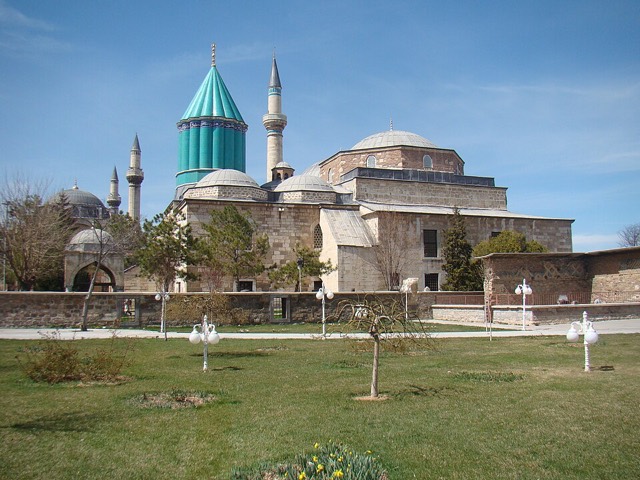
Mevlana Museum
About the Museum
The Mevlana Museum in Konya is the former lodge of the Mevlevi order of dervishes and the resting place of Mevlana Celaleddin Rumi, the thirteenth century poet and mystic whose verses are still read across the world. Rumi died in Konya in December 1273 and was buried beside his father in a garden given to the family by the Seljuk sultan. A year later a turquoise tiled tomb tower was raised over the grave, and for six and a half centuries the buildings around it grew into a community of prayer, music, learning and hospitality. After the dervish lodges of Turkey were closed in 1925, the complex reopened in 1926 as a museum, and it remains both a museum and a place that many visitors treat as a shrine.
You enter through a walled courtyard with a marble fountain, dervish cells along one side and the great kitchen in a corner. Ahead lies the main building: a long hall of tombs beneath painted vaults that leads to the sarcophagus of Rumi under the Green Dome, with the domed sema hall and the small mosque opening off it. Manuscripts, calligraphy, musical instruments, carpets and objects of dervish life are shown in the cells and side halls.
A visit takes about an hour and a half. Dress modestly, keep your voice low near the tombs and remember that people around you may be praying rather than sightseeing.
Before You Go
- Admission is free, so the main queue is for the entrance security check; early morning is the quietest time and Sunday afternoons are the busiest.
- Shoes must be covered with the plastic overshoes handed out at the door of the tomb hall, so wear something easy to slip on and off.
- Dress modestly and speak quietly inside the mausoleum; it is a working place of prayer as well as a museum, and photography with flash is not welcome near the tombs.
- Follow the flow of visitors along the tomb hall to the sarcophagus of Rumi, then double back into the semahane and mosque, and finish in the courtyard cells and the kitchen, which most people miss.
- The whirling ceremony is not performed inside the museum; look for the weekly public sema at the Mevlana Cultural Centre nearby, and plan well ahead if you want to come for the Seb-i Arus commemoration in mid December.
- The Selimiye Mosque next door and the small tombs in the garden are worth ten minutes before you leave.
Collection Areas
Highlights
9 works. Each work has a full written and audio guide.


