Louvre Abu Dhabi
About the Museum
Louvre Abu Dhabi opened in November 2017 on Saadiyat Island as the result of an agreement between the United Arab Emirates and France, which lends the Louvre name, expertise and works from French national museums for a period of decades. It is not a branch of the Paris museum but a new institution with its own growing collection, and its idea is different from any older museum: instead of separating art by country or department, it hangs objects from different civilisations side by side, chapter by chapter, from the first villages to the present day, so that a Chinese bronze, an Egyptian statue and a Greek vase of the same period share a room.
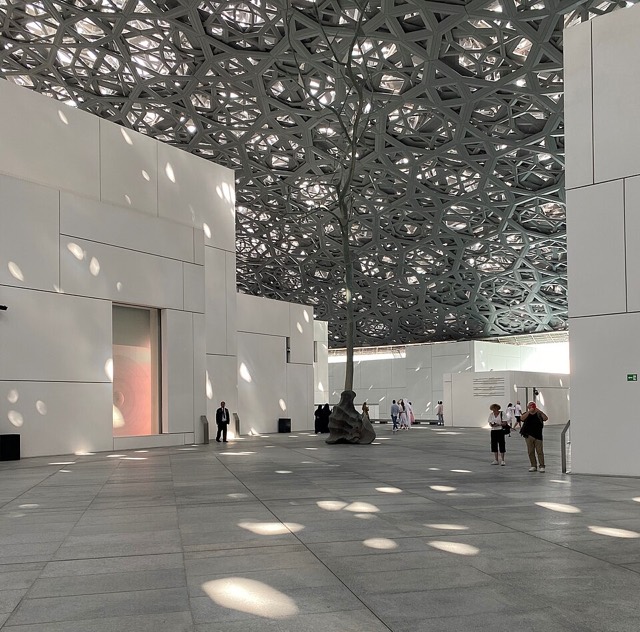
The building by Jean Nouvel is the first exhibit. A cluster of white gallery boxes, like a small town, sits on the water beneath a flat dome one hundred and eighty metres across, made of eight layers of perforated metal. Sunlight passing through them falls as thousands of moving spots, the effect Nouvel called the rain of light. The sea enters the complex through channels and pools, and the outdoor plaza under the dome is open to the sky at its edges.
The permanent galleries follow twelve chapters in a single loop, so the route is easy: follow the sequence, then finish under the dome. Loans from French museums rotate every year or so, so specific famous paintings come and go, while the museum's own acquisitions, including several described here, stay. Two to three hours covers the galleries and the plaza; sunset under the dome is worth timing your visit for.
Before You Go
- Book a timed ticket online; late afternoon lets you see the galleries in daylight and then the dome as the light changes at sunset.
- Follow the numbered chapters of the permanent galleries in order; the route is a single loop and doubling back is confusing.
- Works lent by French museums change regularly, so do not count on seeing a particular Paris painting; the museum's own acquisitions are the reliable highlights.
- The plaza under the dome, the outdoor terraces and the water channels are free to walk once you are inside, and they are the best place for photographs.
- Photography without flash is allowed in the permanent galleries.
- The Children's Museum in a separate wing has its own exhibitions and is included in the ticket; a kayak tour under the dome can be booked separately.
Collection Areas
Highlights
11 works. Each work has a full written and audio guide.


