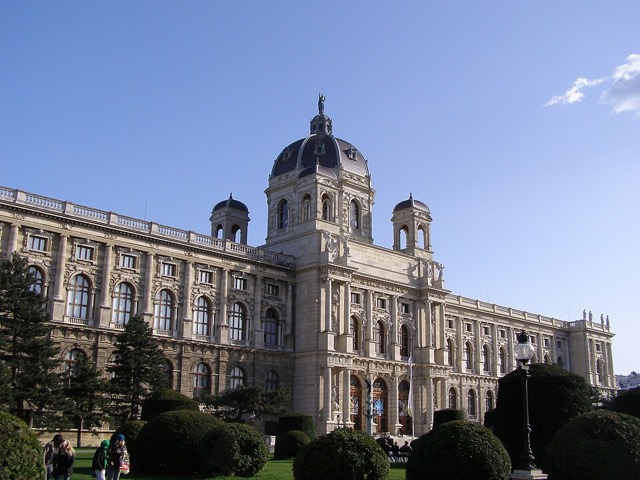
Kunsthistorisches Museum
About the Museum
The Kunsthistorisches Museum, the Museum of Art History, was built by Emperor Franz Joseph to house the collections of the Habsburg family in one palace, and it opened on the Ringstrasse in 1891. Its architects, Gottfried Semper and Carl von Hasenauer, gave it a twin across the square, the Natural History Museum, and a dome sixty metres high. Inside, the marble staircase, the painted ceilings and the gilded galleries were designed to be as impressive as anything hanging on the walls, and they are.
The collection is the result of five centuries of imperial collecting, from the Kunstkammer treasures of Rudolf the Second to the paintings bought in bulk by Archduke Leopold Wilhelm in the seventeenth century. Because the Habsburgs ruled Spain, the Netherlands and much of Italy as well as Austria, the Picture Gallery is unusually strong in Flemish, Venetian and Spanish art. It holds the largest group of paintings by Pieter Bruegel the Elder in the world, Vermeer's Art of Painting, Velazquez's portraits of the Spanish royal children, and major works by Titian, Raphael, Caravaggio, Rubens and Rembrandt.
The building has three levels. The mezzanine, called the Hochparterre, holds the Egyptian and Near Eastern collection, Greek and Roman antiquities and the Kunstkammer with the Cellini salt cellar. The first floor is the Picture Gallery, with Italian, Spanish and French painting on one side of the staircase and Flemish, Dutch and German painting on the other. The second floor holds the Coin Cabinet. Allow three hours, and start with the staircase itself, where Gustav Klimt painted between the columns as a young man.
Before You Go
- Enter from Maria-Theresien-Platz; the cloakroom and lockers are in the basement below the entrance hall and bags larger than a small handbag must be checked.
- Go up the main staircase first to see the Klimt spandrels, Canova's Theseus and the Munkacsy ceiling, then decide between the Picture Gallery on the first floor and the Kunstkammer on the mezzanine.
- The Bruegel room, Room X on the first floor, is the museum's most crowded space; visit it at opening time or in the last hour.
- Rooms with Roman numerals are the large galleries along the outer walls; rooms with Arabic numerals are the small cabinets on the courtyard side, where many of the best small paintings hang.
- The cafe under the dome is an attraction in itself and needs no separate ticket; it is quieter in the late afternoon.
- Photography without flash is permitted in the permanent collection.
- Thursday evenings the museum stays open late and the galleries are at their most peaceful.
Collection Areas
Highlights
12 works. Each work has a full written and audio guide.


