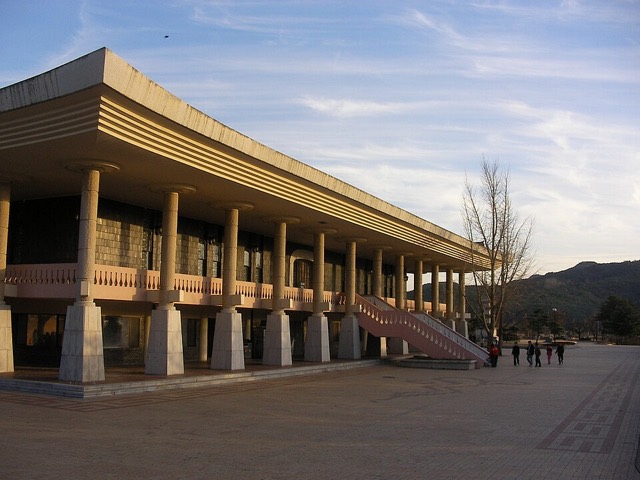
Gyeongju National Museum
About the Museum
Gyeongju was the capital of the Silla kingdom for almost a thousand years, from the first century BC to the tenth century AD, and the whole city is a museum of tombs, temple sites and stone pagodas. The Gyeongju National Museum is where the finds from all of that come together. It began in 1913 as a local antiquarian society, became a branch of the national museum in 1945 and moved to its present campus in 1975, on the southeastern edge of the old city, next to the Wolji pond and a short walk from the royal tumuli.
The campus is a group of low buildings around a wide lawn. The Silla History Gallery holds the gold crowns, belts, jewellery and horse trappings from the great mound tombs of the fifth and sixth centuries. The Silla Art Gallery is devoted to Buddhist sculpture and temple architecture, from gilt-bronze figures to stone pagoda fragments. The Wolji Gallery shows the thirty thousand objects dredged from the palace pond in 1975, and the outdoor exhibition spreads stone pagodas, lanterns and Buddhas across the grounds. Standing under its own pavilion is the Divine Bell of King Seongdeok, the largest surviving bell in Korea.
Allow half a day. The galleries are well labelled in English, the grounds are pleasant in all seasons, and the museum is the best possible preparation for the tombs, the Bulguksa temple and the Seokguram grotto that lie beyond it.
Before You Go
- Admission to the permanent galleries is free; only some special exhibitions charge.
- Start in the Silla History Gallery for the gold crowns, then the Wolji Gallery, then the Silla Art Gallery, and leave the outdoor sculptures and the bell for last.
- The bell is rung only on rare occasions, but a recording of its sound is played next to the pavilion at set times; ask at the information desk.
- Some fragile pieces such as the Cheonmado painting are shown only for short periods, so check the museum website if there is one object you especially want to see.
- The museum is a fifteen minute walk from the Wolji pond and the Cheomseongdae observatory; a bus and taxi stop are at the entrance, and there is a large free car park.
- Photography without flash is allowed in the permanent galleries; tripods are not.
Collection Areas
Highlights
11 works. Each work has a full written and audio guide.


