Museums
Museum Walker

Museum Walker

Contact

Sign In

Enter your email and we will send you a sign-in link. No password needed.

By continuing you agree to our Privacy Policy and Terms of Service.

or
Continue with Google

Unlock the Full Guide

Read every room and listen to every work in all museums with premium.

Unlock Now

Already subscribed?

Renews automatically. Cancel anytime.

Choose Your Language

More languages are on the way.

Doge's Palace

Venice ๐Ÿ‡ฎ๐Ÿ‡น
History / Art12 guided works
See HighlightsStart VisitingGet DirectionsWebsite

About the Museum

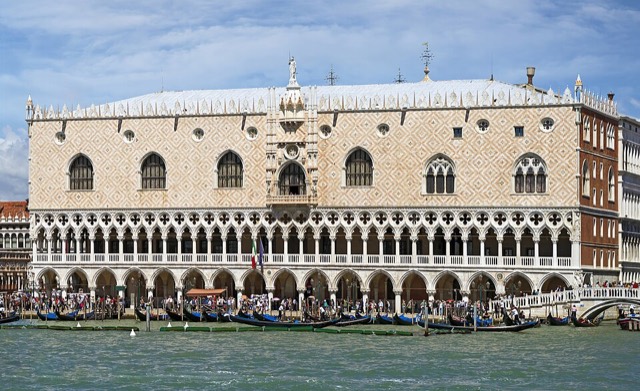
The Doge's Palace was the seat of the Venetian Republic for more than six centuries. It housed the Doge, the elected head of state, and also the great councils, the courts, the state offices and the prisons, so the whole machinery of government lived inside one building beside Saint Mark's Basilica. The pink and white Gothic facades that face the lagoon and the Piazzetta were built in the fourteenth and fifteenth centuries, while the interiors were rebuilt after fires in 1574 and 1577 and decorated by Veronese, Tintoretto, Palma il Giovane and their workshops.

The visit follows a fixed route. It starts in the courtyard, climbs the Giants' Staircase and the Golden Staircase, then passes through the Doge's apartments and the institutional rooms of the second floor: the Collegio, the Senate, the Council of Ten and the armoury. The route then descends to the Hall of the Great Council, the largest room in the palace, with Tintoretto's Paradise on the end wall, before crossing the Bridge of Sighs into the New Prisons and returning to the courtyard.

The rooms are labelled in Italian with English translations, and the palace is one of the Civic Museums of Venice. Allow about two hours for the main route; the Secret Itineraries tour adds the attics, the torture chamber and the cell from which Casanova escaped.

Before You Go

Collection Areas

1
Courtyard and Staircases
Ground floor and first floor
The arcaded courtyard with the two bronze well heads, the Giants' Staircase where the Doge was crowned, and the gilded Scala d'Oro that leads up to the state rooms.
1
2
Doge's Apartments
First floor
The private rooms of the Doge, decorated with carved ceilings and fireplaces by the Lombardo family; they now host temporary exhibitions.
2
3
Institutional Rooms
Second floor
The Sala delle Quattro Porte, the Anticollegio, the Sala del Collegio, the Sala del Senato and the rooms of the Council of Ten, painted by Veronese and Tintoretto.
3
4
Armoury
Second floor
Four rooms of weapons and armour once kept ready for the guards of the Council of Ten.
5
Hall of the Great Council
First floor
The vast assembly hall of the Venetian nobility, with Tintoretto's Paradise, Veronese's Apotheosis of Venice on the ceiling and the frieze of Doges' portraits.
2
6
Bridge of Sighs and Prisons
First floor and ground floor
The enclosed bridge that connects the courtrooms to the New Prisons across the canal, and the prison cells themselves.
2
7
Exterior and Facades
Piazzetta and Riva degli Schiavoni sides of the palace
The Gothic facades of the palace seen from outside, with the Porta della Carta beside the basilica and the carved corner sculptures and capitals of the arcade. Best seen before entering or on the way out.
2

Highlights

12 works. Each work has a full written and audio guide.

The Giants' Staircase
Antonio Rizzo, with statues by Jacopo Sansovino, 1483 to 1491; statues 1567
Courtyard, east side
The Golden Staircase
Jacopo Sansovino and Antonio Abbondi, called Scarpagnino; stuccoes by Alessandro Vittoria, 1554 to 1559
From the first floor loggia to the second floor
Paradise
Paradise
Jacopo Tintoretto, with Domenico Tintoretto and workshop, 1588 to 1592
Hall of the Great Council (Sala del Maggior Consiglio), east wall
The Apotheosis of Venice
Paolo Veronese, about 1582
Hall of the Great Council (Sala del Maggior Consiglio), ceiling, above the throne
Hall of the Collegio
Andrea Palladio and Giovanni Antonio Rusconi (architecture); Paolo Veronese and Jacopo Tintoretto (paintings), 1575 to 1581
Second floor, institutional rooms
Hall of the Senate
Hall of the Senate
Jacopo Tintoretto and workshop, Jacopo Palma il Giovane and others, 1580s to about 1595
Second floor, institutional rooms
Hall of the Scrutinio
Jacopo Palma il Giovane, Andrea Vicentino, Antonio Vassilacchi and others, 1580s to 1690s
First floor, beside the Hall of the Great Council
The Bridge of Sighs
The Bridge of Sighs
Antonio Contin, about 1600 to 1603
Between the palace and the New Prisons, crossing the Rio di Palazzo
The Prisons
The Prisons
Antonio da Ponte and Antonio Contin, 1589 to 1614
New Prisons across the Bridge of Sighs; the Pozzi on the ground floor of the palace
The Porta della Carta
Giovanni Bon and Bartolomeo Bon, 1438 to 1442
Exterior, between the palace and Saint Mark's Basilica; visited from the Piazzetta and from the courtyard
The Drunkenness of Noah
Unknown, Venetian workshop, Early fifteenth century
Exterior, south east corner of the palace, beside the Ponte della Paglia
The Armoury
The Armoury
Various armourers and gunsmiths, Fourteenth to seventeenth century
Second floor, Armoury rooms beside the Council of Ten