21st Century Museum of Contemporary Art
About the Museum
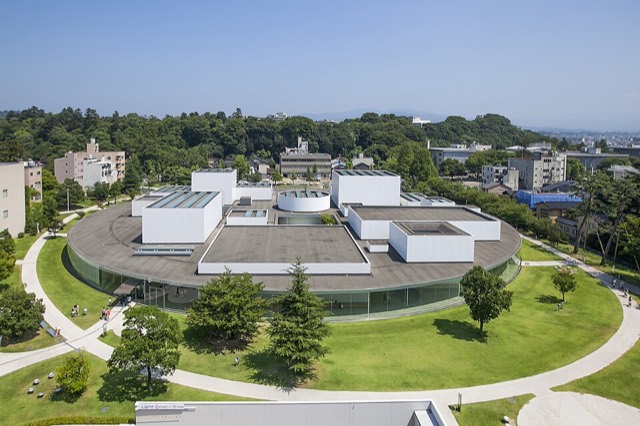
The 21st Century Museum of Contemporary Art opened in October 2004 in the centre of Kanazawa, a short walk from Kenrokuen garden and the castle. It was designed by the architects Kazuyo Sejima and Ryue Nishizawa of SANAA, and the building itself is the first exhibit: a low glass circle about one hundred and thirteen metres across with no front and no back, so that people can walk in from any side of the surrounding park. Inside, white cube galleries of different heights are scattered like boxes within the circle, separated by corridors and four glazed courtyards that pull daylight deep into the plan.
The museum was built as a place for the city rather than a temple of art. Roughly half of the floor area is a free public zone with a library, a cafe, a shop, a lecture hall and a children's studio, and several of the most famous works were commissioned for that zone so that anyone can enjoy them without a ticket. The exhibition zone, which needs a ticket, holds the changing shows and the ticketed parts of the permanent commissions. The collection concentrates on art made after 1980, on works that respond to the building, and on artists connected to Kanazawa and its craft traditions.
The permanent commissions are the reason most visitors come. Leandro Erlich's Swimming Pool, James Turrell's Blue Planet Sky and Olafur Eliasson's Colour activity house are all here, along with outdoor pieces on the lawn by Florian Claar, Jan Fabre, Patrick Blanc and Anish Kapoor. Give yourself two hours, walk the full circle of the corridor at least once, and step outside to see the building from the grass, where it looks like a glass lens resting on the ground.
Before You Go
- The free zone, with the shop, cafe, library and several permanent works, can be entered without a ticket; the exhibition zone with the changing shows and the underside of the Swimming Pool needs a ticket.
- The Swimming Pool is the most popular work and the underwater room is often run on timed entry with a queue; go early on a weekday or check the museum website for the current system.
- Blue Planet Sky is best in changing light; late afternoon or a cloudy day gives the most dramatic colour in the square of sky.
- The building has four entrances and no obvious front; the closest to the bus stop and Kenrokuen is on the Hirosaka side.
- Walk the lawn outside to find the outdoor commissions by Florian Claar, Olafur Eliasson, Jan Fabre and others; they are free and open even when the galleries are shut on Mondays.
- Photography is allowed for the permanent commissions in most conditions, but temporary exhibitions often restrict it; look for the signs at each gallery door.
Collection Areas
Highlights
6 works. Each work has a full written and audio guide.


